
India's steel market is out of step with global trends. Global demand is weak with China at a huge supply surplus to its domestic demand, pushing down global steel prices. India's domestic demand for steel is strong, given the continuing infrastructure push and is likely to accelerate as urbanisation improves, and the auto sector continues to grow alongside the infrastructure push.

'Suddenly we had a new comprehension of affairs, which reminded that the luxury of politics floated atop a foundation by economics.' 'Along with this, finance ministers became crucial in molding the perception and reputation of Union Cabinets.' 'Governments couldn't afford a wrong person in that portfolio,' asserts Shyam G Menon.

There is a reason this 11 year phenomenon is a rule as much as it is an observation. It speaks to the nature of man and what humans are like, explains Aakar Patel.

It's always been a struggle for economists and statisticians to forecast India's gross domestic product (GDP) correctly, and say where the economy is headed before the official numbers come out. If estimating the GDP is tough, forecasting it in real time is complicated. It involves looking at tens of indicators, such as industrial production, electricity consumption and exports, to arrive at a number.
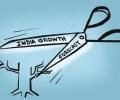
India's projected economic growth for 2022 has been downgraded by over two per cent to 4.6% by the United Nations, a decrease attributed to the ongoing war in Ukraine, with New Delhi expected to face restraints on energy access and prices, reflexes from trade sanctions, food inflation, tightening policies and financial instability, according to a UN report released on Thursday. The UN Conference on Trade and Development (UNCTAD) report downgraded its global economic growth projection for 2022 to 2.6 per cent from 3.6 per cent due to shocks from the Ukraine war and changes in macroeconomic policies that put developing countries particularly at risk. The report said while Russia will experience a deep recession this year, significant slowdowns in growth are expected in parts of Western Europe and Central, South and South-East Asia.

Subramanian recommended five ways of financing additional expenditure over a period of one year, including cutting expenditure and borrowing directly from the RBI or monetising debt.

The average cost of data breaches in India reached $2.18 million in 2023, marking a 28 per cent increase since 2020, according to the Reserve Bank of India's (RBI) Currency and Finance report for 2023-24. The report said that India's average data breach cost was still below the global average. The most common attacks in India are phishing which was at 22 per cent and stolen or compromised credentials was 16 per cent. The automotive industry is highly vulnerable to cyber attacks, whereas the banking and financial services sector, benefiting from stringent regulations, enjoys comparatively stronger protection.
The EIU said in a report on Wednesday forecast that the real GDP grew by 1.6 per cent quarter-on-quarter in India, but noted that this uptick was largely owing to base effect.

India can sustain 8 per cent annual GDP growth and the conducive macroeconomic configuration may become a launching pad for a step-up in the country's growth trajectory, said an article on the 'State of Economy' in the central bank's March Bulletin published on Tuesday. Over the period 2021-24, gross domestic product (GDP) growth has averaged above 8 per cent. The global economy is losing steam, with growth slowing in some of the most resilient economies and high frequency indicators, pointing to further levelling in the period ahead, said the article authored by a team led by RBI Deputy Governor Michael Debabrata Patra.

Sanjay Malhotra on Wednesday took charge as the 26th Governor of the Reserve Bank of India. Malhotra, a career bureaucrat, arrived at the central bank's headquarter this morning, where he was welcomed by senior RBI staffers. The central bank confirmed Malhotra's appointment through a post on the microblogging site "X" and also shared a few pictures.

India has undermined its own credibility.

Dominic Xavier asks if it is right to blame coronavirus and the lockdown for India's economic decline.

Indian economy is in a sweet spot, with a mix of solid growth and moderating inflation, Moody's Ratings said, forecasting a 7.2 per cent GDP growth in the 2024 calendar year and 6.6 per cent in the next. In its Global Macro Outlook 2025-26, the rating agency said the global economy has shown remarkable resilience in bouncing back from supply chain disruptions during the pandemic, an energy and food crisis after the Russia-Ukraine war began, high inflation and consequent monetary policy tightening.

It is projected to cross the $3 trillion mark in 2019

While most economies contracted in the second quarter of 2020, the Chinese economy grew by 3.2 per cent.

Gold imports more than doubled in August to a record high of $10.06 billion, mainly on account of a drastic cut in customs duty and ongoing festive demand, according to the Commerce Ministry data. Gold imports stood at $4.93 billion in August 2023. On record high imports, Commerce Secretary Sunil Barthwal said that the tariff rates on gold have been reduced drastically so that smuggling and other activities can come down.

The panel finds 'discrepancy' in the Annual Survey of Industries data.

The country's GDP is likely to grow at 1.3 per cent in the fourth quarter of 2020-21 and may see a contraction of around 7.3 per cent for the full financial year, according to an SBI research report 'Ecowrap'. The e-National Statistical Office (NSO) will release the GDP estimates for the March 2021 quarter and provisional annual estimates for the year 2020-21 on May 31. "Based on our 'nowcasting model', the forecasted GDP growth for Q4 would be around 1.3 per cent (with downward bias) as against NSO (National Statistical Office) projection of a negative (-)1 per cent," the research report said.

'When people have money in their hands, they make their judgment about whether they want to spend it entirely or spend some out of it.'

'There will be no change of seats for Delhi, Assam and Maharashtra.' 'Andhra, J&K, Kerala, Punjab, Karnataka, Tamil Nadu, Odisha, West Bengal and Telangana will lose seats while there will be an increase for MP, UP, Bihar, Haryana, Gujarat and Chhattisgarh.' 'It is a big mistake if you make it a north-south issue.'

'If it doesn't, it will continue with measures to infuse liquidity, signalling a new cycle,' predicts Tamal Bandyopadhyay.

Capital markets are becoming more prominent in India's growth story, with an expanding share in capital formation and investment landscape on the back of technology, innovation and digitisation, according to the Economic Survey 2023-24 tabled in Parliament on Monday. Further, Indian markets are resilient to global geo-political and economic shocks, it added. "Despite heightened geo-political risks, rising interest rates and volatile commodity prices, Indian capital markets have been one of the best performing among emerging markets in FY24," the Economic Survey said.

It will be interesting to see what shifts have been recorded in the last decade-and-a-half -- from the effects of demonetisation and Covid's second wave to the drop in fertility and increase in farm workers -- but we will only know this if and when the Census is conducted, points out Aakar Patel.

Moody's Investors Service on Tuesday lowered India's GDP growth forecast for the 2020 calendar year to 5.3 per cent, on coronavirus implications on the economy. Moody's had in February projected a 5.4 per cent real GDP growth for India in 2020. This too was a downgrade from 6.6 per cent earlier forecast.

'Challenge is basically near-term growth as the outlook has turned a bit adverse.'

For 2020 calendar year, it reduced the estimate by a similar measure to 6.7 per cent.

The travel and tourism sector's contribution to global gross domestic product will return to pre-pandemic levels by the end of 2024, according to a new report by the World Economic Forum (WEF) on Tuesday. This recovery is driven by a considerable increase in worldwide demand, coinciding with more available flights, better international openness, and increased interest and investment in natural and cultural attractions.

Global factors and FII activity will dictate trends in domestic equity markets this week while assembly poll results of Maharashtra and Jharkhand may impact stocks on Monday, say analysts. Stock markets witnessed a spirited recovery on Friday with benchmark Sensex and Nifty notching the best single-day gains in more than five months and offering relief after weeks of correction.

Investors' sentiments will be guided by a host of domestic and global macroeconomic data announcements this week, along with the trading activity of foreign investors and trends in world stocks, analysts said. Besides, the rupee-dollar trend and movement of global oil benchmark Brent crude will also be crucial in dictating terms in the market, experts added.

Retail investors have become a force to reckon with in the last 10 years with their ownership of Indian equities rising 800 basis points, or 8 per cent, to 23.4 per cent during this period, suggests a recent note from Morgan Stanley. This number, Morgan Stanley said, is set to rise in the next few years as Indian households are still underinvested in equities. India's demographics, policy framework, investor education and modest positive real rates, it said, will fuel the 'equity cult' in India.

With the fiscal deficit target staring at the government, the FY25 Budget has limited expenditure options, points out A K Bhattacharya.

'As for tricky relations with China, India needs less of summitry type event management and more anticipatory analysis and management of events,' says Ambassador Jaimini Bhagwati.

While the ratio determines the extent to which the government is able to finance its expenditure, it is also an indicator of tax compliance. Developed countries have a higher contribution of tax to their GDP.

'Spend, but create assets, spend but make sure that people benefit from it.' 'This has been a beautiful guiding principle. And I think as a finance minister I owe so much to the prime minister for keeping this path clear before us.'

From connectivity woes to infrastructure advancements and the startup boom, there is a gulf between claims and reality in India's economic landscape, points out Devangshu Datta.
'Growth, liquidity and deposit mobilisation are likely to be discussed during the interaction.'

'Over the next 20 years, we would be adding almost 10 million people to the workforce every year!' 'And we won't be able to give employment to even 2 million out of the 10 million every year.' 'Don't forget, it keeps adding every year.'

'Not only jobs are not being generated, but people are also losing jobs.'

the GDP estimates incorporate new source data and modified compilation techniques

'If our Budget allows, we may implement both measures -- making income up to Rs 10 lakh tax-free and introducing a 25 per cent slab for income between Rs 15 lakh and Rs 20 lakh.'
